5 OEM Integration Methods, Custom Gel Formulations and Flexible Manufacturing Solutions for Memory Foam Pillow Factories
Are you a memory foam pillow manufacturer looking to develop cooling pillows, upgrade your existing product range, or create more differentiated bedding products?
Adding cooling gel to memory foam pillows is one way to introduce a new comfort feature without necessarily redesigning the entire pillow.
However, different pillow factories use different production methods. Some prefer to integrate gel during foam molding, while others attach gel sheets to finished pillows or incorporate removable gel inserts into pillow covers.
The right cooling gel solution depends on your pillow design, manufacturing process, target market, and product requirements.
At Kunbao, we have specialized in gel material manufacturing since 2011.
We supply custom PU gel sheets, hydrogel sheets, fabric-backed gel materials, and finished gel inserts to memory foam pillow manufacturers and OEM bedding brands.
With more than ten gel formulations and over 400 existing molds, we help manufacturers select suitable gel materials and integration methods for different pillow designs.
Memory foam is widely used in pillows because it provides contouring support and pressure distribution.
However, some users find that conventional memory foam pillows feel warm during prolonged contact.
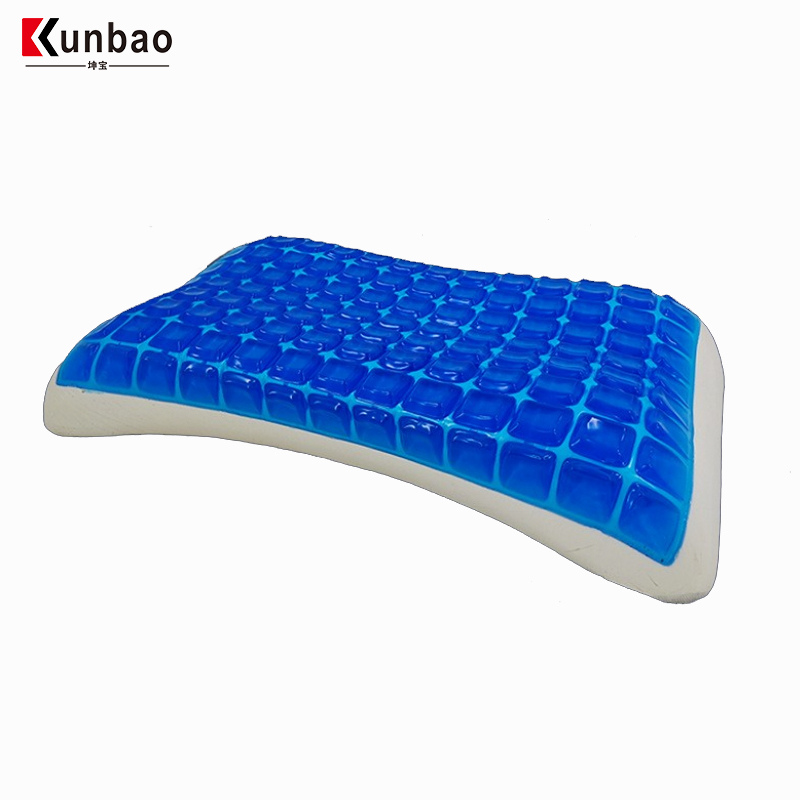
Cooling gel sheets can be incorporated into selected pillow designs to modify the surface feel and initial heat-transfer characteristics.
Depending on the material and construction, cooling gel may offer several product-development advantages.
Certain cooling gel formulations can absorb and transfer heat from the contact surface, creating an initial cooling sensation.
The actual performance depends on the gel material, thickness, pillow cover, and surrounding environment.
Soft gel sheets can add a flexible cushioning layer to selected pillow structures.
Manufacturers can develop different pillow models using custom gel shapes, colors, thicknesses, and surface patterns.
Gel sheets can be incorporated into pillows using several manufacturing methods, allowing factories to select a process that suits their existing equipment.
Cooling gel can help manufacturers develop differentiated products for customers seeking additional comfort features.
Commercial results depend on the product design, market positioning, and customer demand.
Not all cooling gel sheets use the same formulation or structure.
Kunbao offers different gel material options according to the customer's intended application.
PU gel is a flexible polyurethane-based material used in cooling and cushioning applications.
Depending on the formulation, PU gel sheets can be customized in hardness, thickness, color, shape, and surface design.
Selected PU gel structures can be integrated with memory foam through suitable bonding or molding processes.
Hydrogel is a water-containing polymer material.
Certain hydrogel formulations can provide a strong initial cool-touch sensation.
For pillow applications, manufacturers should also evaluate moisture retention, protective films, sealing, and long-term material stability.
These gel sheets incorporate a fabric backing that can support selected sewing, lamination, or pillow cover assembly methods.
The appropriate fabric and construction depend on the finished pillow design.
Gel sheets can be developed with selected protective film structures, such as compatible TPU, PVC, or EVA films.
Film selection should consider flexibility, surface properties, moisture-barrier requirements, and manufacturing compatibility.
Custom gel inserts can be supplied with suitable finishing or edge structures for integration into pillow covers or dedicated compartments.
Memory foam pillow manufacturers can work with Kunbao using different production methods.
Each approach offers different advantages depending on the factory's equipment and product design.
<text color="secondary" italic>In-Mold Gel Integration</text>
In this method, a suitable cooling gel component is positioned inside the memory foam mold before the foam is formed.
The foam is then produced around or against the gel component using a compatible molding process.
After curing and demolding, the gel becomes part of the pillow structure.
Typical production process:
Prepare the cooling gel component.
Position the gel inside the foam mold.
Carry out the compatible foam molding process.
Allow the foam to cure.
Remove and inspect the finished pillow.
Advantages:
Gel can be integrated during pillow production.
Suitable for selected custom molded pillow designs.
May reduce the need for a separate post-molding bonding operation.
Important consideration: The gel must be compatible with the foam chemistry, mold conditions, and curing process. Not every gel formulation is suitable for in-mold integration.
<text color="secondary" italic>Surface Bonding with a Suitable Adhesive</text>
This is a practical option for manufacturers that already produce finished memory foam pillows.
A cooling gel sheet is bonded to the pillow surface using a compatible adhesive system.
For selected gel and foam combinations, a suitable water-based PU adhesive may be considered.
Typical production process:
Prepare the finished memory foam pillow.
Select the appropriate cooling gel sheet.
Apply a compatible adhesive according to its instructions.
Position the gel sheet on the foam surface.
Apply suitable pressure.
Allow the adhesive to cure.
Inspect the finished pillow.
Advantages:
Existing memory foam pillow molds may be retained.
Suitable for upgrading selected pillow designs.
Different gel sizes and shapes can be evaluated.
Can be incorporated into existing production workflows.
Important consideration: Adhesive compatibility, bond strength, flexibility, and cooling performance should be evaluated before mass production.
<text color="secondary" italic>Gel-Infused Foam Formulation</text>
Some memory foam manufacturers prefer to develop gel-infused foam rather than attach a separate gel sheet.
This method involves incorporating suitable gel additives or compatible gel-related materials into the foam formulation.
The purpose is to create a modified foam structure with targeted material characteristics.
Typical development process:
Review the memory foam formulation.
Select a compatible gel additive or material system.
Conduct small-scale foaming trials.
Evaluate foam structure and physical properties.
Adjust the formulation where necessary.
Confirm the finished foam performance.
Advantages:
No separate surface gel sheet is required.
The gel-related material is incorporated into the foam structure.
Suitable for selected foam formulation development projects.
Important consideration: Gel-infused foam is not equivalent to a solid cooling gel sheet. Its cooling behavior, formulation compatibility, and physical properties require separate evaluation.
<text color="secondary" italic>Fabric-Backed Gel for Sewn Pillow Covers</text>
In this method, the pillow manufacturer purchases cooling gel sheets with a suitable fabric backing.
The factory then incorporates the gel component into the pillow cover during sewing and assembly.
Depending on the design, the fabric backing or designated fabric margins can provide a suitable sewing interface.
Typical production process:
Select a fabric-backed gel sheet.
Prepare the pillow cover materials.
Position the gel component.
Sew the designated fabric areas into the pillow cover.
Complete the cover assembly.
Fit the cover onto the memory foam pillow.
Advantages:
Suitable for pillow factories with sewing capabilities.
Gel can be incorporated into selected cover designs.
The foam core may remain unchanged.
Custom gel dimensions and fabric backing options are available.
Important consideration: Sewing should be performed through suitable fabric areas rather than directly puncturing gel structures that are not designed for stitching.
<text color="secondary" italic>Ready-to-Use Cooling Gel Inserts</text>
For manufacturers that prefer a simpler assembly process, Kunbao can develop finished gel inserts with suitable backing and edge-finishing structures.
The pillow factory places the prepared gel insert into a dedicated pocket or compartment inside the pillow cover.
The gel insert is not necessarily visible on the finished pillow surface.
Typical production process:
Confirm the gel insert dimensions and construction.
Prepare the pillow cover with a suitable compartment.
Insert the finished gel component.
Close or secure the compartment.
Assemble the pillow cover onto the foam core.
Inspect the finished product.
Advantages:
Reduces gel-processing steps at the pillow factory.
Suitable for selected removable or enclosed insert designs.
The original foam pillow may remain unchanged.
Custom insert sizes and structures can be developed.
Important consideration: The pocket design should prevent unwanted movement, folding, or bunching of the gel during use.
The most suitable method depends on the manufacturer's production capabilities and product requirements.
| Integration Method | Suitable Manufacturer | Main Consideration |
|---|---|---|
| In-mold gel integration | Memory foam molding factories | Foam and gel compatibility |
| Surface bonding | Existing memory foam pillow factories | Adhesive and bonding quality |
| Gel-infused foam | Foam formulation manufacturers | Additive and foam chemistry compatibility |
| Fabric-backed gel | Pillow cover sewing factories | Fabric structure and sewing design |
| Finished gel inserts | Pillow assembly factories and brands | Insert positioning and cover construction |
Manufacturers do not need to use all five methods.
The best approach is to select the process that matches the existing equipment, target product, and required performance.
Customization is one of the main advantages of working directly with a gel material manufacturer.
At Kunbao, cooling gel materials can be developed according to different OEM specifications.
We have more than ten gel formulations with different material characteristics.
Different formulations may be selected according to softness, flexibility, surface properties, and application requirements.
Gel hardness can be adjusted to suit different pillow designs.
Some customers prefer very soft gel, while others require a firmer material for their assembly structure.
Gel thickness affects flexibility, weight, cost, and the finished pillow's surface feel.
The appropriate thickness depends on the material, molding method, and product design.
Gel sheets can be developed for:
Standard memory foam pillows
Contoured cervical pillows
Ergonomic pillows
Travel pillows
Custom-shaped pillows
Other OEM pillow designs
Gel materials can be developed in different colors according to formulation feasibility and customer requirements.
Options may include flat surfaces, textured designs, grid patterns, and other moldable structures.
Depending on the application, gel sheets may incorporate:
Release paper
Fabric backing
Protective films
Other compatible composite structures
Selected gel inserts can be developed with appropriate edge-finishing or enclosure structures.
The final construction should be selected according to the material and intended use.
Both PU gel and hydrogel can be considered for cooling pillow applications.
However, they have different material characteristics.
| Feature | PU Gel | Hydrogel |
|---|---|---|
| Material type | Polyurethane-based gel | Water-containing polymer gel |
| Cooling behavior | Depends on formulation and structure | Can provide strong initial cool-touch sensation in suitable formulations |
| Softness | Customizable | Formulation-dependent |
| Foam bonding | Possible with compatible structures | Requires evaluation of backing and adhesive compatibility |
| In-mold integration | Possible for suitable formulations | Requires specific process validation |
| Moisture retention | Depends on construction | An important design consideration |
| Protective films | Optional according to structure | Often relevant for moisture and surface protection |
| Customization | Available | Available |
Higher thermal conductivity does not automatically mean that a gel will stay cool longer.
The actual cooling performance of a finished pillow depends on the gel, foam, cover fabric, thickness, and test conditions.
Kunbao has comparative thermal performance information for selected PU gel and hydrogel materials.
Customers can review the available information when evaluating material options.
There is no single gel thickness or hardness suitable for every memory foam pillow.
The appropriate specification depends on:
Pillow shape
Foam density and softness
Gel coverage area
Bonding or integration method
Desired surface feel
Product weight
Manufacturing cost
Cooling performance requirements
For example, a gel sheet used on a highly contoured pillow may need different flexibility from a gel sheet used on a flat pillow.
A thicker gel sheet may add more weight and may not conform as easily to tight curves.
Manufacturers should evaluate physical samples before confirming their production specifications.
Yes, in many cases.
This is one of the practical advantages of surface bonding and pillow cover integration methods.
Manufacturers may be able to retain their existing memory foam molds and develop cooling versions of selected products.
Possible approaches include:
Bonding a suitable gel sheet to the foam surface
Adding a fabric-backed gel component to the cover
Inserting a finished gel component into a cover compartment
The final method should be selected according to the pillow structure and manufacturing process.
This allows factories to evaluate cooling gel product development without necessarily investing in completely new foam molds.
Before mass production, manufacturers should evaluate the gel material and finished pillow according to their target market and application.
Potential considerations include:
Relevant REACH documentation and other applicable material evaluations.
Appropriate tests for initial cooling sensation and heat-transfer characteristics.
Evaluation of softness, support, and recovery behavior.
For surface-bonded gel sheets, adhesive compatibility and durability are important.
Gel dimensions and thickness should match the approved pillow design.
Additional testing may be required according to the customer's specifications.
Repeated compression, handling, and cleaning conditions may affect the complete pillow structure.
Kunbao has relevant REACH, RoHS, and halogen documentation for selected PU gel materials, as well as REACH documentation for selected hydrogel materials.
Additional testing requirements should be confirmed according to the exact material and finished product.
For pillow manufacturers, cost depends on the entire production process rather than the gel sheet price alone.
Several factors can affect the total cost:
Gel formulation
Material grade
Gel thickness
Gel coverage area
Mold requirements
Adhesive or lamination process
Labor and assembly
Packaging
Production quantity
Defect and rework rates
Some pillow designs may not require full-surface gel coverage.
A custom-shaped gel insert may provide a suitable solution for selected contact areas.
Different formulations have different material characteristics and cost structures.
Kunbao has more than 400 existing molds that may help reduce development requirements for suitable projects.
For some factories, bonding gel to finished foam may be more practical.
For others, fabric-backed or finished inserts may reduce assembly complexity.
Sample evaluation helps identify manufacturing problems before large-volume orders.
The goal is to achieve a suitable balance between product performance, manufacturing efficiency, and cost.
Kunbao provides gel material customization and manufacturing support for OEM pillow manufacturers.
Customers provide the pillow dimensions, shape, production method, and target requirements.
We review possible PU gel, hydrogel, or composite structures according to the application.
Specifications may include:
Gel formulation
Hardness
Thickness
Color
Shape
Surface pattern
Backing material
Edge finishing
We prepare samples according to the agreed requirements.
For standard formulations and existing molds, sample development may be relatively quick.
Custom formulations, tooling, and complex structures may require additional development time.
Customers test the gel materials using their actual foam, pillow covers, adhesives, or manufacturing equipment.
Once the sample and production requirements are approved, bulk manufacturing can be arranged according to the agreed specifications and order quantity.
Kunbao is a custom gel material manufacturer based in China.
We have focused on gel material manufacturing since 2011 and work with manufacturers developing cooling and comfort products.
Our advantages include:
More than 15 years of gel manufacturing experience
More than ten gel formulations
Different raw material grades
PU gel and hydrogel manufacturing
More than 400 existing molds
Custom sizes, shapes, hardness, thickness, and colors
Fabric-backed and film-laminated gel sheets
Custom finished gel inserts
Gel and foam composite development
Free mold development for eligible OEM projects
Sample development and mass production support
Relevant material test documentation for selected formulations
We understand that different pillow factories use different production processes.
Rather than offering only one standard gel sheet, we help customers evaluate suitable materials and integration methods for their existing manufacturing operations.
Yes. Kunbao manufactures customized cooling gel sheets for OEM pillow factories, including different dimensions, thicknesses, hardness levels, colors, and backing structures.
Yes, when the gel surface, foam, and adhesive are compatible. Bonding performance should be confirmed through sample testing.
Certain gel materials can be integrated during compatible foam molding processes. The gel formulation and foaming conditions must be evaluated.
Fabric-backed gel components can be incorporated into suitable pillow cover structures. Sewing should be performed through appropriate fabric areas.
Yes. Custom gel inserts with selected backing and edge-finishing structures can be developed for pillow cover integration.
Yes. Kunbao has more than ten gel formulations for different material and application requirements.
Yes. Gel hardness and thickness can be customized within the capabilities of the selected formulation and manufacturing process.
Free mold development is available for eligible OEM projects, subject to the agreed design and commercial requirements.
Relevant REACH, RoHS, and halogen documentation is available for selected PU gel materials. REACH documentation is available for selected hydrogel materials.
Yes. Sample development is available so manufacturers can evaluate material compatibility and product performance before confirming mass production.
Cooling gel sheets offer memory foam pillow manufacturers several ways to develop differentiated cooling and comfort products.
Whether your factory uses in-mold gel integration, surface bonding, gel-infused foam, fabric-backed gel, or finished gel inserts, the most suitable method depends on your production process and target product.
At Kunbao, we provide more than standard gel sheets.
With over 15 years of manufacturing experience, more than ten gel formulations, and over 400 existing molds, we support customized gel material development for OEM pillow manufacturers.
Looking for custom cooling gel sheets for your memory foam pillow factory?
Share your pillow design, gel requirements, and preferred manufacturing method.
Our team can help you evaluate suitable materials and develop samples for your project.
REQUEST CUSTOM GEL SAMPLES | DISCUSS YOUR OEM PILLOW PROJECT
Kunbao — Custom Gel Materials & Solutions Manufacturer Since 2011
Website: www.kbcoolgel.com
 Hot News
2026-08-20
2026-09-08
2026-10-06
2026-09-09
2026-10-11
2026-10-05


 EN